
Project aims to address issues of food security and racial justice on York Road Corridor
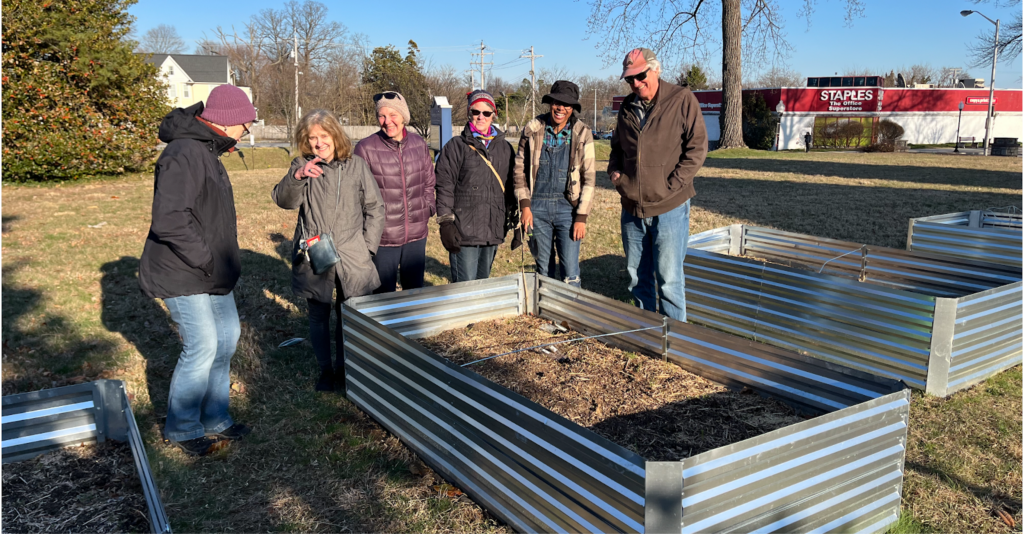
Members of Govans Presbyterian’s “farm team” include, from left, Deb Dalton, Deb Smith, Drue Hadgetts, Bonnie Thomson, Latavia Hoggard and Peter Conrad. Not pictured is Lammot du Pont.
Govans Presbyterian Church is converting a large part of its front lawn into a community farm as the congregation continues its work to address issues of food security and racial justice on the York Road Corridor.
With an emphasis on healthy eating, the farm will produce “lots of brassicas,” says Latavia “Farmer Tay” Hoggard, an expert gardener who is part of the core team working to turn the idea of an urban farm into a reality. Vegetables in the brassica family are high in nutrition and low in calories.
“We’ll have some cabbage, some kale, some brussels sprouts, collards, spinach, lettuce,” says Hoggard. “Then there’s all the nightshades–peppers, tomatoes, the eggplants and all of that stuff. And we’ll have flowers, lots and lots of flowers, to bring pollinators for the vegetables and beneficial insects to take care of pest control, organically.”
The church, at 5828 York Road, expects to devote about a third of an acre to the farm. Plans call for the site, once it is fully built out, to have in ground planting areas, raised beds (including some that are wheelchair-accessible), native fruit trees, herb beds, a pollinator meadow, a flower garden with black-eyed susans and marigolds, a rain garden with underground water storage, a compost area and a pavilion that will be available for community events.
The public is invited to attend a grand opening on April 19 from noon to 3 p.m. “It’s a kickoff to get some things in motion,” said Bonnie Thomson, another member of the seven-person planning team. “It’s not a finished product, but it’s the launch of what we hope is a successful Govans Community Farm.”
The project “started as a response to our own investigation about the history of the church,” says Peter Conrad, also a member of the core team.
“The research uncovered that the founders of Govans Presbyterian had derived some of their wealth from enslaved individuals,” he says. While enslaved, these persons “were working on the land, but then, after slavery, people of color have often been disconnected from the land in urban areas like Baltimore.”
One of the goals of the farm project is to restore that broken connection. “We want to engage with the greater Govans community, which is predominantly African American, so that everyone can participate in the farming process,” Conrad says.”Most urban farms in Baltimore City are not just about growing vegetables. They’re about connecting to another missing element within the greater community.”
The Govans farm could address some of the other gaps in the community, he says. These needs include lower food costs, wider availability of fresh produce, nutrition counseling and job training.
Another goal of the farm is to make connections across York Road, a thoroughfare that for decades has served as a dividing line not only between East and West but also between rich and poor and black and white. “We’ve brought in people from both sides [of York Road] to help with the committee,” Thomson says. “Our church is all about that.”
The farm planners have gone door-to-door throughout the community to promote the project. They also hope to build on an existing relationship between the church and Govans Elementary School.
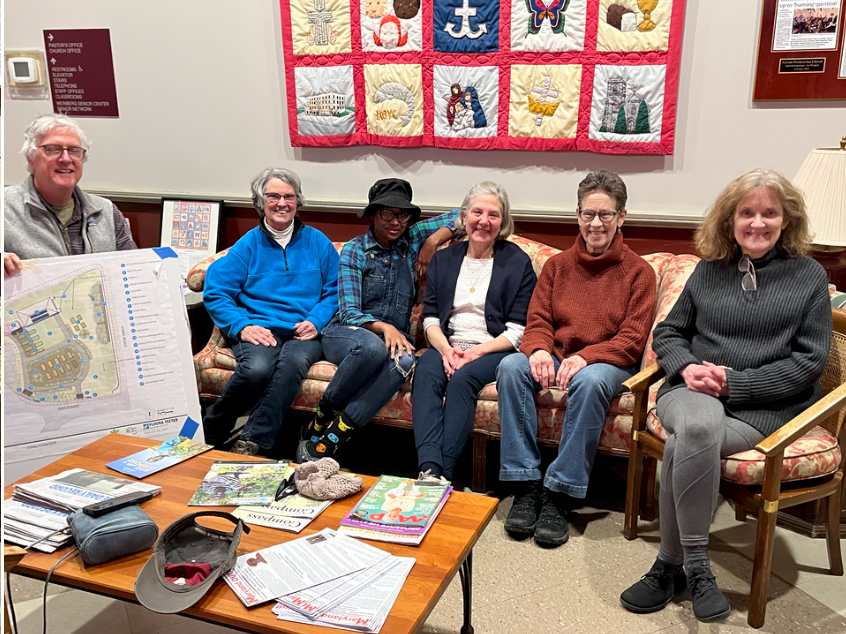
Govans Community Farm team members display a concept drawing of the project.
Hoggard, who has one daughter who graduated from Govans and another getting ready to start, has asked the school to bring back a gardening club that it used to have. She is also planning to help create a garden for the students there.
The planning team has a conceptual drawing of what the farm would look like, but members also say that they are still looking for input from the community.
“We’re trying to proceed with all due deliberation, because we don’t want to overextend ourselves, and we want to make sure that we’re connecting,” says Conrad. “With the grand opening event, we’ll seek additional feedback from the greater community.”
Growing food for the community is not a new initiative for Govans Presbyterian. For 17 years, it has planted several gardens that have produced fresh vegetables for GEDCO’s CARES food pantry.
Plans call for some of the higher output from the new garden plots to be sold at farmers markets as a way of covering costs and achieving sustainability. Govans has joined the Farm Alliance of Baltimore, which will give it a presence at the 32nd Street Farmers Market in Waverly. Another outlet will be the Govans Farmers Market in the 5100 block of York Road.
More than $200,000 has been raised for the farm and related improvements so far, much in the way of grants from the Chesapeake Bay Trust and through the state’s Baltimore Regional Neighborhood Initiative. “The National Wildlife Federation is helping with pollinator plants,” says core team member Deb Smith.
Another supporter has been Nature Sacred, an Annapolis nonprofit that promotes the use of green spaces as places of healing and spiritual growth. Incorporated into the farm area is a Nature Sacred bench, part of a nationwide network of sites that give “visitors a place to sit, reflect and enjoy the surroundings the space provides.”
The bench is one of the ways that the church is inviting community members into the farm experience. There are also lots of opportunities for volunteers to contribute their time and talents.
“We’ve got 500 plants, native pollinators, coming around the 20th of April, and we’re going to have a planting day, a sod cutting day, several opportunities for volunteers,” says Smith.
“We’re probably going to have a barn raising type event for the pavilion.” says Conrad “It’ll probably be delivered in pieces, and then we’ll have some type of public event to reach out to people.”
Starting in April Tuesday afternoons will be time for the “farm team” members to work the garden beds. “From 4:30 to 6:30 the farm team will be here, harvesting, planting,” says Thomson. “Community members would be most welcome to come.”
To learn more about the Govans Community Farm, including volunteer opportunities, write to govansfarm@govanspres.org.