Two recent surveys indicate residents would like to see greater community trust, more fun things to do, and better public spaces
York Road has long been one of Baltimore’s most distinctive commercial corridors — a linear spine threading together communities with deep histories, profound disparities, and evolving aspirations. Two recent surveys reveal a community at a crossroads: rich with social connection and local pride yet burdened by decades of disinvestment, bifurcation, and fragmented growth.
These surveys indicate both challenges and opportunities, some of which are being addressed through efforts to revitalize Govans’ public spaces, add more community events, and build trust within and among neighborhoods that have settled into uneasy relationships.
In responses to the York Road Community Needs Assessment, which ran at the end of 2025 and included 78 responses from mostly on-the-street conversations, community members consistently describe York Road as a place with deep social networks and local loyalty, even when parts of the corridor feel under-resourced or overlooked. As one long-time neighbor observed, “People here care about York Road – they want it to work, they just don’t see it reflected in investment.”
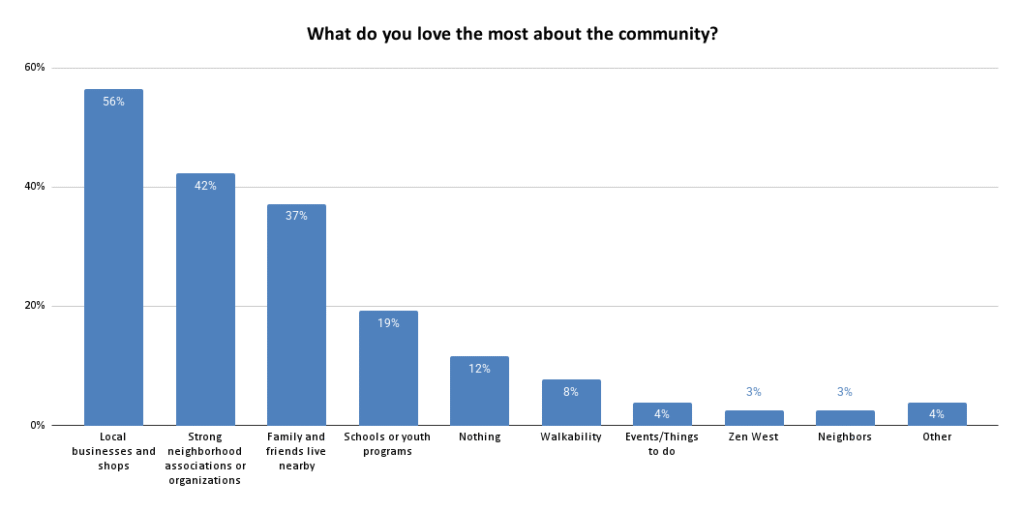
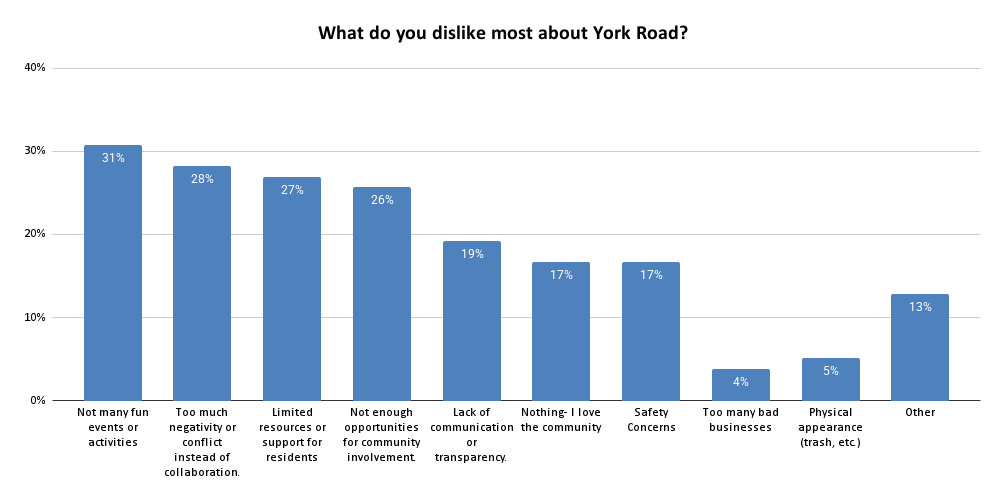
Survey respondents most frequently cited local businesses, community relationships, and neighborhood identity as the corridor’s greatest strengths. Yet this affection sits beside clear frustration: residents also cited limited entertainment options, concerns about safety and cleanliness, and a lack of coordinated communication about corridor happenings as significant gaps.
These perceptions align with the Baltimore Development Corporation’s recent Commercial District Assessment (CDA), a first-of-its-kind data profile that combines more than 2,600 on-the-ground observations with demographic, real estate, and infrastructure data for York Road and other major corridors across the city. The CDA underscores a number of structural realities shaping the corridor’s current state:
- Commercial streetscape conditions are uneven, with pockets of well-maintained storefronts adjacent to blocks of vacancy and deferred maintenance.
- Income levels within a 15-minute walk of the corridor vary widely, capturing both lower-income households and moderate earners — yet local spending is significantly leaking outside the corridor to other commercial centers.
- Foot traffic and transit access, while present thanks to CityLink Red service, remain under-leveraged relative to the corridor’s potential role as a regional commerce hub.
These mixed conditions reflect the historic divide that has long shaped York Road’s trajectory. The road itself has operated as both connector and separator — separating more affluent west side blocks from the more modest neighborhoods to the east, such as Woodbourne-McCabe, Wilson Park, Pen Lucy, and Winston-Govans. Over decades, this divide was reinforced by white flight, uneven public investment, and fragmented redevelopment strategies that prioritized certain nodes while other stretches remained undercapitalized. Today, that legacy shows in vacancies, aging infrastructure, and inconsistent business mix along key segments of the corridor.
Sam Storey, YRID’s Executive Director, frames the current challenge plainly: “York Road isn’t lacking in identity or community energy, but it is lacking in coordinated investment that reflects the lived realities of those who use it every day.” This is borne out in our survey results: when asked about the most pressing challenges facing the corridor, residents ranked economic insecurity, limited youth opportunities, and lack of a shared vision near the top.
Importantly, these data points point not just to deficits but to opportunity. The CDA data suggest that capturing more local spending, particularly on food, drink, and services, could reinvigorate the corridor if paired with targeted business support, improved storefront activation, and real estate investment strategies that reduce vacancy. Combined with community feedback, the data suggest that residents want spaces that are safe, inviting, and coordinated, rather than piecemeal improvements.
“The good news is that strategic interventions are already underway to address these realities,” says Storey. “The Community Needs Assessment and Commercial District Assessment help contextualize and reinforce the direction of that work.” Indeed, residents consistently identified the need for cleaner, safer, and more welcoming public spaces, clearer communication, and more opportunities to gather along the corridor, priorities that align with investments already in progress. Recent improvements include visible public-space projects such as the transformation of the Bellona Triangle into a maintained and programmed green space, as well as early planning and site activation efforts at long-vacant properties, including the former diner lot on the 5800 block of York Road, which address long-standing concerns about vacancy and corridor conditions.
Survey responses also underscored concerns related to safety, stability, and repeated crisis; in parallel, the York Road Improvement District has expanded comprehensive community outreach and harm reduction initiatives, pairing daily corridor presence with behavioral health engagement, service navigation, and workforce pathways. Community members’ desire for more activity and connection along York Road is reflected in ongoing and upcoming corridor-wide events at Belvedere Square, along with community-building initiatives led by the York Road Partnership and Invest York Road that aim to strengthen cross-neighborhood ties.
Together, these efforts point toward a more coordinated, trust-based approach to revitalization, one grounded in both lived experience and data. As Storey notes, “The best version of York Road is one where investment reflects both economic realities and community aspirations — not either/or.”
York Road’s current state, at once hopeful and uneven, reflects a broader urban truth: revitalization that is not rooted in community insight will always underperform. By combining rich, street-level feedback with rigorous commercial data, stakeholders now have a clearer picture of both the corridor’s challenges and its potential. The task ahead is to forge that insight into coordinated action that bridges divides, reduces fragmentation, and ensures that York Road’s next chapter is defined by shared opportunity.
