Three-person team canvasses York Road to connect with people in need
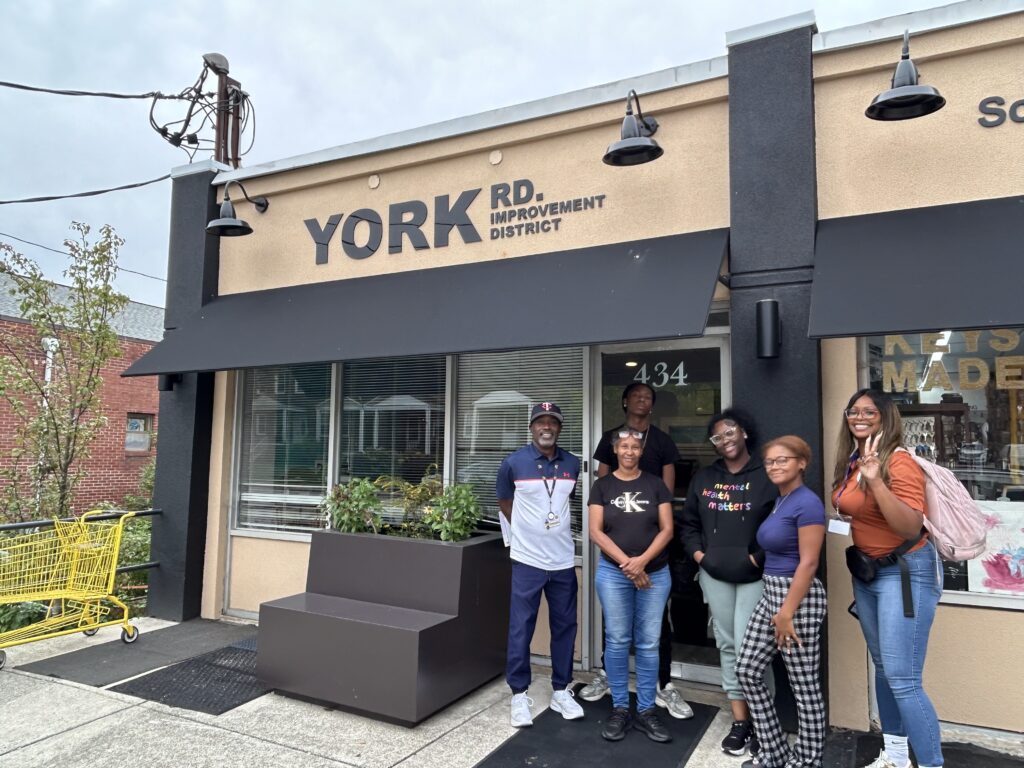
York Road Improvement District’s new Outreach Team with partners from the Mayor’s Office of Neighborhood Safety and Engagement
A street-based outreach program has been launched by the York Road Improvement District to address interrelated problems of economic insecurity, housing instability, behavioral health and public safety.
A three-person team, led by longtime community activist Phyllis Gilmore, has begun canvassing the Corridor with a goal of developing relationships that will encourage individuals to access support services and pursue job opportunities.
“Basically what we do is we walk down York Road, we talk to people, we engage,” said Kenice Williams, an outreach specialist whose position is partially funded through the state’s Maryland Service Year Option program.
“We create relationships, and then we gather information,” she said. “That’s how we figure out what they need, what resources you can bring them, how we can help them.”
Gilmore gave two examples of persons the team is currently helping. She described one young man who has asked for help in getting ready to apply for a job. The first step is connecting him to resume preparation services, which are available through GEDCO’s CARES Program, which works in partnership with the Mayor’s Office of Employment Development (MOED).
“After we get him help with his resume, the next step is getting him ready to apply for a job, make him aware of how you talk at an interview,” she said. “We want him to know what to say to employers, how to be successful at your job, how to show you know what the job carries.”
In another case, the outreach team is working with an elderly woman whose home has become so rundown that it is no longer habitable. “It needs a lot of work: windows, floors, heating,” Gilmore said. “So I connected with her yesterday, walked her though the LIGHT program,” which helps residents access low- and no-cost services, including weatherization and building rehabilitation.
“I will be sitting with her this weekend, to step her through the application, and then I will be getting that back to the program, if I have to take it down to 317 Fayette myself,” Gilmore added, referring to the offices of the city’s Department of Housing & Community Development.
“I’m a young man, and I know how they look at us,” said Taeqwan Carter, who is the team’s other outreach specialist. “We look bad on the news. Look at what Trump said about us.” But he believes the BID’s Community Programs Initiative can change the stereotypes about Baltimore.
“We’re trying to do something big for the community,” he said. “We’re trying to change Baltimore. We’re trying to be a spotlight for good news and not bad news.”
The outreach team is connecting with potential clients while also putting together a database of available services. This process involves vetting potential resources to make sure they are in a position to provide the help they advertise.
“We’re not just giving [clients] a list of resources and saying, ‘Good luck!’” said Sam Storey, the BID’s executive director. “We’re connecting them, walking them over if necessary, getting them an Uber there, if necessary, keeping them accountable to follow-up – and tracking their progress along the way.”
Although the York Road Corridor seems to have no shortage of behavioral health clinics, Storey said there are not enough readily available resources for the outreach program’s clients.
“Trying to find available mental health support on York Road, services that are not necessarily tied to drug addiction but are available to help with generalized depression, PTSD, trauma – that’s been a tricky thing to find,” Storey said.
“York Road has been kind of challenging,” added Gilmore. She said her team has approached York Road businesses that provide behavioral health services and found most of them are not accepting new patients. “We’re actually right now trying to figure out a way how we can get into our churches, building a relationship with our churches” as many have their own networks of counseling and mentorship to support local youth. Eventually she hopes to engage more productively with the private clinics to make better use of the many behavioral health resources that exist on York Road.
“We all want to go back to the businesses to see if we can talk to them and build a relationship with them,” Gilmore said.
The next phase for the program is a workforce development component. The plan is to create five-person cohorts in which individuals would be employed by the BID in “cleaning and greening” for 20 hours a week. Over a three-month period, they would also take part in structured job training modules, one-on-one case management and certification programs in fields like landscaping or hospitality. The goal is to serve 15 persons a year.
Any individuals or families are eligible for the outreach initiative, but 18- to 26-year-old males are expected to make up a majority of clients, with middle-age men close behind.
By engaging these individuals and helping them find jobs, the BID is hoping to make a difference in improving public safety on the York Road Corridor.
“Public safety aligns with the guy sitting on York Road who doesn’t have anything to do,” Gilmore said. “They don’t have anybody that’s advocating for them. They don’t have job opportunities or resources that they can actually go on York Road and go in this building and say, ‘I need X, Y and Z.’”
She predicted that “once we can get them the services and the help that they need” the neighborhood will feel, and be, safer.
On some blocks of York Road, “when people drive by, when people walk by, there’s a feeling that they aren’t in a safe community,” Storey said. The new program is designed to change that perception by creating a more welcoming, walkable environment. The goal is to address the needs of people in crisis directly, connecting them to long-term case management and supportive opportunities rather than simply displacing them.
“The idea is that those who are lingering on the street are getting help and moving toward better paths, which in turn makes the corridor feel safer and more vibrant for everyone,” Storey said.
The BID is working with “a robust network of community partners,” he said. These include Roca, Glenwood Life Counseling Center, LifeBridge Health, Safe Streets, GEDCO, Loyola University Maryland, the Baltimore Police Department, and Councilman Mark Conways’s 4th District Office.
The outreach effort has been funded through a $200,000 award from the Performance Incentive Grant Fund (PIGF) of the Governor’s Office of Crime Prevention, Youth and Victim Services.